


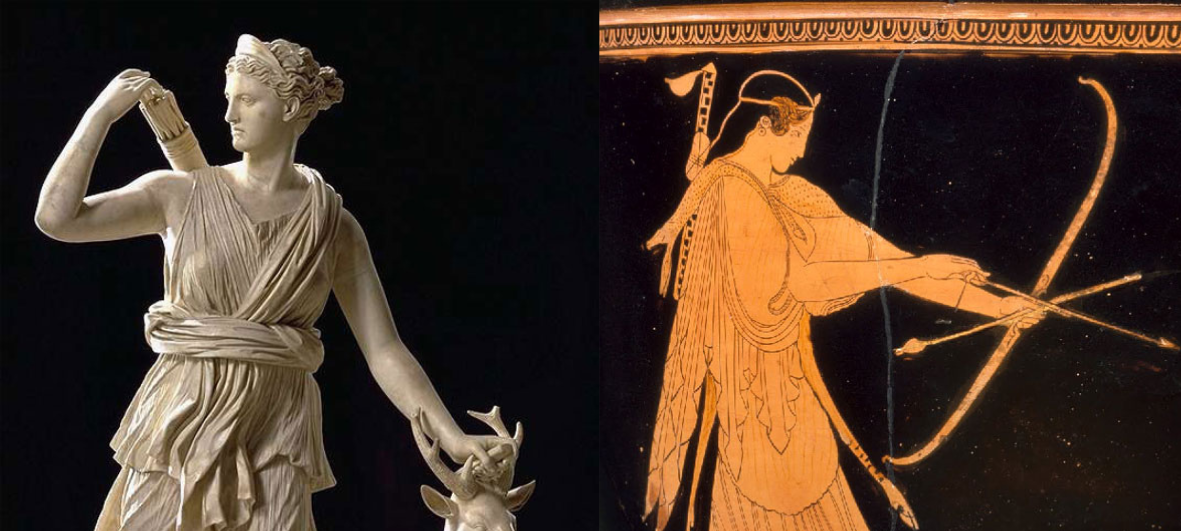
Artemis
Read why Artemis soap contains cypress, cedar and laurel:
Artemis was one of the Olympian gods, daughter of Zeus: king of the gods. She was the goddess of the hunt and the wilderness, and was often depicted with a bow and arrow. But everything related to childbirth also fell under her control. In some myths about her own birth, it is said that Artemis assisted her mother in the delivery of her twin brother, Apollo.
Artemis and Apollo were born on an island thickly covered with cypress trees. The cypress tree was thus dedicated to Artemis and became part of her sanctuary. Her priests and priestesses were expected to remain chaste throughout their lives. One of the most famous temples dedicated to her (or a derivative of her) is the Temple of Artemis in Ephesus, built partly from cedar wood. For this reason, Artemis is sometimes called the "Lady of the Cedar."
A well-known story in which Artemis plays a role is that of the nymph Daphne. Daphne was dear to her, and the goddess granted her the gift of archery. Daphne swore to remain chaste in honor of Artemis. But Apollo, Artemis's brother, was captivated by Daphne's beauty and pursued her against her will. To protect her chastity and save her from Apollo's tyranny, Daphne prayed for help. In some stories, she turned to her father; in others, to Zeus or Artemis herself. At the last moment, she was transformed into a laurel tree. In ancient Greek, the tree bears the name Daphne, and it became the symbol of Apollo. Nevertheless, the laurel also remained under the sanctuary of Artemis.
This story illustrates how transgressive behavior was portrayed in Greek mythology: although Apollo was the perpetrator, the laurel tree ultimately became his symbol, while Daphne's side of the story faded into the background.